

▪ UNCATEGORIZED
Small Business Automation: Start With the Thing No Customer Will Ever See
Updated October 23, 2026

Updated October 23, 2026
Search for small business automation and you will find the same article fifteen times. Twenty-five things to automate. Fifteen tasks. Ten tools. Near the top of every list: social posting, email follow-up, review requests, chatbots, appointment reminders.
Every one of those is customer-facing. Which means every one of them is a bad place to start.
The short answer
Automate inward first. Your first automation should be internal work that no customer ever sees — order entry, data moving between systems, internal reporting. If it breaks on a Tuesday, the only people who find out work for you. Customer-facing automation comes later, after you have learned how yours fails.
Why the lists point the wrong way
Those articles are not wrong by accident. Most of them are published by companies that sell a tool, and the easiest tools to sell are the ones that touch marketing and customer communication — they demo well, they show a number in a dashboard, and they can be bought without changing how the business actually runs.
So the recommendation gets shaped by what is sellable rather than by what is safe. And customer-facing work is the least safe thing in your business to hand to a system you have never operated before, for a simple reason: when it breaks, it breaks in front of the person paying you.
Failure is not a hypothetical here. S&P Global Market Intelligence’s 2025 survey found that 42% of companies had abandoned most of their AI initiatives, up from 17% the year before — reported in the trade press as “AI project failures surge to 42% as companies struggle to scale.” Most first attempts do not survive. The question is not whether yours will stumble. It is who is standing there when it does.
The blast radius test
Before you automate anything, ask one question about it: if this breaks on a Tuesday and nobody notices for a day, who finds out?
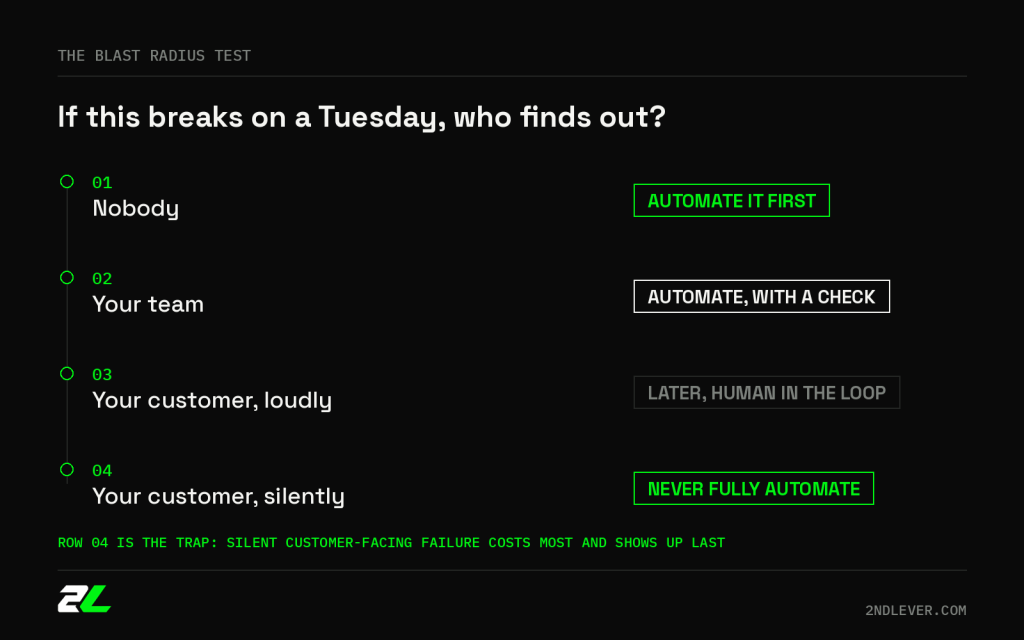
The fourth row is the one that costs real money, and it is the one nobody thinks about. Loud failures are survivable — an email that does not send gets noticed, somebody calls, you fix it. Silent failures are the expensive kind: the system keeps running, the output looks completely normal, and it is wrong. You find out weeks later from a customer who is already angry.
Anything in row four stays partly manual, permanently. Not because automation cannot do it, but because the cost of being quietly wrong is higher than the cost of a person looking.
What we did, and what it cost us to learn this
Our first real automation was order entry. Twenty-seven retail stores, each sending its own spreadsheet in its own format, roughly 100 line items each, every SKU re-typed by hand at about an hour per order.
Completely internal. No customer ever saw it, knew it existed, or noticed when it changed. That is the only reason it was a sane place to start — and it is the whole point of this post, because it broke.
The early version could not reliably tell two stores apart. A store’s identity is not its name — it is the name plus its customer ID. Same chain, different locations, identical spelling. Until every line carried both, the output looked perfectly correct and was wrong. That is a row-four failure, and we hit it inside a row-one process.
Because the blast radius was internal, that failure cost an afternoon of checking and a fix. Put that same bug in an automated customer invoice or an inventory feed to a retailer, and it costs credits, apologies, and some portion of a relationship you spent years building. Same bug. Entirely different bill.
That system is now about ten minutes a week with two manual steps left, and it took roughly a year and a half of versions to get there — Make.com first with no AI in it at all, then a prompt, then Make connected to Claude. The full build is written up here. The relevant part is that we got to make every early mistake somewhere nobody was watching.
The second reason to start inward
There is a quieter benefit. Internal work is work you control completely.
When we built the order system, the obvious move was to ask 27 stores to submit orders in one standard format. That is the efficient-sounding answer and it would have failed, because every one of those businesses would have had to change how they work to solve a problem that was ours. Instead the system absorbs their formats exactly as they already send them.
Customer-facing automation almost always has this shape — it needs someone outside your building to behave a certain way. Internal automation does not. You can change it on a Wednesday afternoon without asking anyone’s permission, which means you can iterate, and iteration is the thing that actually produces a working system.
So what should you actually automate first?
Not a list. The right answer depends on your business, which is exactly what the twenty-five-things articles cannot know. But the shape is consistent. The best first candidate is internal, frequent, rule-based, and currently done by retyping something that already exists somewhere else in a digital form.
Moving data between two systems that do not talk. Entering what arrived by email into whatever you keep records in. Assembling the same internal report from the same three places every week. Checking one list against another.
Before you commit to any of them, two checks still apply: confirm the work should exist at all — deleting it is cheaper than automating it — and count the hours before you build rather than estimating them.
What to do Monday morning
Take the list you were working from, whatever article it came from, and run every item through one filter:
- Cross out everything a customer would see if it misfired. Not forever — just not first.
- Of what is left, keep only the things that happen at least weekly and follow a rule you could write down.
- From those, pick the one where somebody is retyping information that already exists in digital form somewhere else. That is your first build.
You will almost certainly end up with something unglamorous that nobody outside your company will ever notice. That is the correct answer. The first automation’s real job is not to save the most hours — it is to teach you how automation fails in your business, somewhere that failing is cheap.
Not sure which one is yours?
A Lever Audit walks how your business actually runs and hands back a prioritized map — what to eliminate, what to keep human, what to document, and what is genuinely worth building, each with its numbers and its blast radius attached.
It takes a couple of conversations and enough access to see how work moves. It is $500, credited toward implementation if you decide to build something.
FAQ
What should a small business automate first?
Something internal, frequent, and rule-based — usually work where a person retypes information that already exists digitally somewhere else. Order entry, moving data between systems that do not talk, assembling a recurring internal report. Save customer-facing automation for after you have one working system behind you.
Isn’t automating marketing and follow-up the fastest win?
It is the fastest thing to buy, which is not the same thing. Those tools are heavily marketed because they are easy to sell and easy to demo. They can be the right call — but as a first automation they put your learning curve in front of customers, which is the most expensive classroom available.
How much should a first automation cost?
Less than the hours it returns in a year, and that requires counting the hours rather than estimating them. A process eating 80 hours a year can justify real money. One eating four hours a year cannot justify anything at any price, no matter how annoying it feels.
Do we need AI, or will plain automation do?
Plain automation, usually, at first. Our own order system ran for a long time with no AI in it at all. AI earns its place when the input is messy and varied — different formats from different senders. Repetitive and structured is a job for ordinary automation, which costs less and breaks less often.
What if the work we want to automate is customer-facing and it is genuinely the biggest problem?
Then build it with a person in the loop rather than fully automated — the system drafts or prepares, a human releases. You get most of the time back and keep the failure loud instead of silent. Remove the human only once you have watched it be right for a few months.